Tablet Hardness Tester: Choose the Right Equipment
A tablet hardness tester measures the force required to break or crush a tablet. Pharmaceutical QC, production and R&D teams use it to assess mechanical strength, monitor compression consistency and support decisions related to packaging, handling and product performance.
Choosing the right tester is not only about force range. The best equipment should match your tablet size, testing volume, required units, data-recording needs and available accessories.
This guide explains how a tablet hardness tester works, what to check before buying, and how the TBF 100i Tablet Hardness Tester can support a reliable pharmaceutical testing workflow in Egypt.
Need Help Choosing a Tablet Hardness Tester?
Send Gemicatech your tablet type, maximum diameter, required force range, daily sample volume and data requirements. Our team can help you identify the suitable configuration and request a complete quotation.
What Is a Tablet Hardness Tester?
A tablet hardness tester, also called a tablet breaking force tester, measures the force needed to fracture a tablet. The result is commonly expressed in newtons, kiloponds, kilograms-force or pounds-force, depending on the laboratory method.
The test helps pharmaceutical teams understand whether a tablet has suitable mechanical strength. It does not replace dissolution, disintegration or friability testing; instead, it provides an important physical-quality measurement within a wider QC plan.
In practical terms, a tablet that is too soft may chip, break or fail during handling and packaging. A tablet that is too hard may create challenges during disintegration or dissolution. Hardness testing helps laboratories monitor this balance consistently.
Why Tablet Hardness Matters
Tablet hardness can influence how a product behaves during compression, coating, packaging, transport and patient handling. A consistent hardness profile supports better control of the manufacturing process and helps identify changes between batches.
For pharmaceutical QC, production and R&D laboratories, the measurement is especially useful when evaluating compression settings, formulation changes, tooling condition and batch consistency.
Hardness testing is one part of a complete solid dosage form workflow. You can review the wider equipment plan in the pharmaceutical tablet testing equipment guide .
TBF 100i: A Compact Tablet Hardness Tester
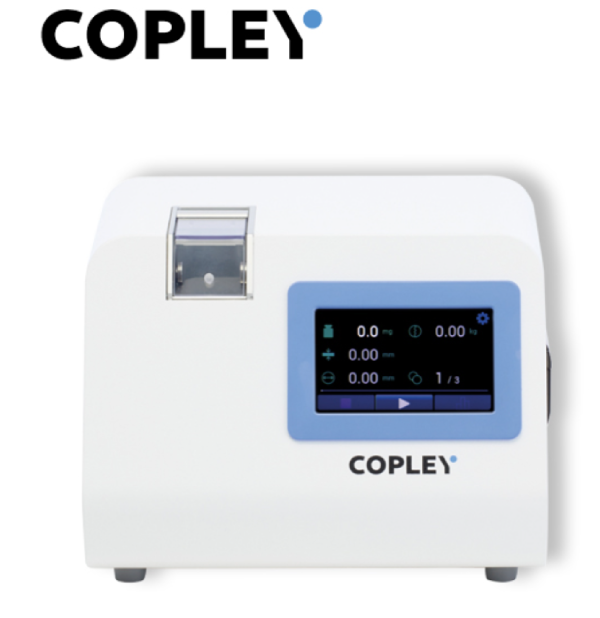
The TBF 100i is a compact, microprocessor-controlled tablet hardness tester designed to deliver precise tablet hardness and diameter measurements. It combines a simple operating workflow with digital data collection and statistical reporting.
The instrument is listed as compliant with Ph. Eur. 2.9.8 and USP 1217. It is suitable for laboratories that need dependable tablet breaking-force measurements while keeping the unit footprint manageable.
| Specification | Published Information | What to Confirm |
|---|---|---|
| Pharmacopoeial compliance | Ph. Eur. 2.9.8 and USP 1217. | Suitability for your approved test method. |
| Maximum tablet diameter | 36 mm. | Compatibility with your tablet dimensions. |
| Force range | 0–490 N. | Required force range for your products. |
| Measurement units | Kg, Kp, N and lbs. | Units required by your SOP and reporting format. |
| Force application | Constant speed. | Method-specific operating conditions. |
| Data reporting | RS 232 and USB B outputs. | Connection and data-export requirements. |
| Statistics and batch testing | Supported. | Sample volume and reporting workflow. |
| Optional measurements | Tablet thickness and weight. | Required accessories and integration. |
The TBF 100i includes an intuitive touchscreen interface that simplifies test setup. Its built-in data processor supports tablet breaking-force statistical analysis, helping laboratories review results efficiently.
Load speed and fracture-detect percentage are configurable, with passcode protection to prevent unauthorized adjustment of set values. This can support controlled operation in a pharmaceutical quality environment.
How to Choose the Right Tablet Hardness Tester
A good purchasing decision starts with your actual testing requirements. A tester that is suitable for one product or laboratory may not be the best fit for another workflow.
Check Tablet Size and Force Range
Confirm the maximum tablet diameter and the expected breaking force before selecting a model. The TBF 100i supports tablets up to 36 mm in diameter and offers a force range of 0–490 N.
If your laboratory tests larger tablets, unusual shapes or products with higher mechanical strength, share these details with the supplier before requesting a quotation.
Define Your Testing Volume
A QC department that tests many tablets per batch should review batch-testing capability, repeatability and reporting options. The TBF 100i supports batch testing and statistical reporting, which can help organize routine quality-control work.
For R&D teams, the ability to compare formulations and record results clearly may be equally important. Define whether the tester will be used mainly for routine QC, in-process checks, method development or formulation studies.
Review Data Handling and Access Control
Digital data collection can reduce manual recording and support clearer laboratory documentation. The TBF 100i provides RS 232 and USB B output options for data reporting.
Confirm how results will be transferred, stored and reviewed in your laboratory. The exact data and documentation requirements should be aligned with your quality and validation teams.
Consider Ease of Use and Bench Space
The TBF 100i has a compact footprint of 283 × 237 × 208 mm, making it suitable for laboratories that need reliable testing without dedicating excessive bench space.
A touchscreen interface can also reduce setup time and help operators follow a consistent testing routine. Confirm the operator workflow with your QC team before finalizing the purchase.
Thickness and Weight: Useful Additions to Hardness Testing
Tablet hardness is important, but it is not the only physical characteristic that supports product understanding. Thickness and weight can provide additional context when evaluating tablet consistency and manufacturing performance.
Tablet Thickness Measurement
A Mitutoyo thickness measuring gauge can be attached to the TBF 100i to add thickness data to the other tablet characteristics captured by the instrument.
This can be useful when the laboratory needs to review diameter, hardness and thickness together. Confirm the gauge configuration and integration requirements before ordering.
Tablet Weight Measurement
A Sartorius balance, model Quintix 224-1 CEU, can be connected to add tablet weight data to the TBF 100i workflow.
Combining hardness, diameter, thickness and weight data can give the laboratory a more complete view of tablet characteristics. The required accessories should be selected according to the actual SOP and reporting needs.
Do You Need a Tap Density Tester Too?
If your laboratory also works with powders, capsule filling or formulation development, a tap density tester may be a useful addition to the equipment plan.
Tap density testing evaluates powder behavior after controlled tapping. It supports powder characterization and formulation decisions, while tablet hardness testing focuses on the finished tablet’s mechanical strength.
Hardness Testing Within a Complete QC Workflow
A tablet hardness tester works best when it is part of a clear quality-control plan. It helps evaluate mechanical strength, while other instruments assess different product characteristics.
| Quality Parameter | Instrument | What It Helps Evaluate |
|---|---|---|
| Mechanical strength | Tablet Hardness Tester | Force required to break or crush a tablet. |
| Drug release | Dissolution Tester | Release behavior of the active ingredient. |
| Break-apart time | Disintegration Tester | Time required for the dosage form to break apart. |
| Abrasion resistance | Friability Tester | Resistance to chipping and surface wear. |
| Powder packing behavior | Tap Density Tester | Change in powder volume after controlled tapping. |
If your laboratory needs a broader equipment plan, review the pharmaceutical tablet testing equipment guide . It explains how dissolution, disintegration, hardness, friability and density testing can work together in one QC workflow.
What Should a Tablet Hardness Tester Quotation Include?
| Quotation Item | Information to Request |
|---|---|
| Main instrument | Exact model, force range and maximum tablet diameter. |
| Measurement units | Required units, such as N, Kp, Kg or lbs. |
| Thickness measurement | Mitutoyo thickness gauge and integration details. |
| Weight measurement | Sartorius balance model and connection requirements. |
| Data output | RS 232, USB B and reporting requirements. |
| Documentation and service | Manuals, installation, training, calibration and support. |
| Commercial conditions | Current price, taxes, warranty, delivery terms and lead time. |
Share your tablet type, dimensions, expected force range, sample volume and data requirements with Gemicatech. This helps ensure that the quotation includes the correct instrument and accessories.
Service and Support: Protect Your Laboratory Investment
A tablet hardness tester is a long-term laboratory investment. Reliable installation, operator training, calibration support and access to spare parts can help maintain consistent performance.
Gemicatech provides technical support and after-sales coordination for laboratory equipment in Egypt. You can review the available support approach in the laboratory equipment after-sales service guide .
Before purchasing, confirm the project-specific service scope in writing, including installation, training, maintenance and spare parts availability.
Frequently Asked Questions
What does a tablet hardness tester measure?
A tablet hardness tester measures the force required to break or crush a tablet. The result helps laboratories evaluate mechanical strength and monitor consistency between tablets or batches.
Why is tablet hardness important in pharmaceutical QC?
Tablet hardness helps assess whether a tablet can withstand handling, packaging and transport. It also supports monitoring of compression consistency and identification of changes in tablet performance.
Is tablet hardness the same as friability?
No. Hardness measures the force required to break a tablet. Friability evaluates resistance to abrasion, chipping and mechanical stress. Both tests provide useful but different information.
What force range does the TBF 100i support?
The TBF 100i supports a force range of 0–490 N. Confirm that this range is suitable for your tablet products and approved test method.
What is the maximum tablet diameter for the TBF 100i?
The TBF 100i supports tablets up to 36 mm in diameter. Share your tablet dimensions with the supplier before ordering to confirm compatibility.
Can the TBF 100i measure tablet thickness and weight?
Yes. Tablet thickness and weight measurement are optional capabilities. The system can be equipped with a Mitutoyo thickness measuring gauge and a Sartorius Quintix 224-1 CEU balance.
Does the TBF 100i support data export?
Yes. The instrument provides RS 232 and USB B output options. Confirm the required connection and data-transfer workflow with your laboratory IT and quality teams.
Is the TBF 100i compliant with USP and Ph. Eur.?
The product page lists compliance with Ph. Eur. 2.9.8 and USP 1217. Confirm the suitability of the instrument for your specific approved method and quality requirements.
How much does a tablet hardness tester cost in Egypt?
Request a current quotation covering the main instrument, required accessories, data connections and support. A base-unit price may not include thickness or weight measurement accessories.
Does Gemicatech provide tablet hardness testers in Egypt?
Yes. Gemicatech provides the TBF 100i tablet hardness tester and can support equipment selection, quotation requests and after-sales coordination in Egypt.
Choose a Tester That Matches Your Real Workflow
The right tablet hardness tester should match your tablet size, force range, testing volume and documentation needs. The TBF 100i offers a compact, digital solution for laboratories that need reliable tablet breaking-force measurements.
Send Gemicatech your tablet specifications and testing requirements to discuss the suitable configuration and request a written technical and commercial offer.